Why can one small moment ruin an entire day?
It’s something a lot of us feel innately sensitive to and acutely aware of. That is, moments that may be everyday occurrences, yet we experience them as deeply distressing, invalidating, or as a judgement on who we are. For example, we might be halfway through telling a story in a social setting when someone talks over us or changes the subject. Or we might invest a lot of time and emotional energy into a gift or gesture, only to receive a lukewarm response from the recipient. Maybe we don’t hear back from an interview or application, and find ourselves ascribing this to some kind of internal deficit specific to us. Common to each of these experiences is a sense of deep, profound rejection we might find ourselves replaying over and over again, convincing ourselves that we are unworthy or somehow dislikable. If any of these experiences sound familiar, you may be uniquely familiar with something called rejection sensitivity dysphoria, which is especially common in neurodivergent populations. For those of us who have been shamed for taking criticism too hard, or have been called “too sensitive” to the point that we believe it, we aren’t alone and we aren’t defective. Read on to learn more.
What is rejection sensitivity dysphoria?
Rejection sensitive dysphoria (RSD) is an intense, often overwhelming emotional response to rejection/criticism or the sense that you've let someone down, regardless of whether this rejection is real or only perceived.
Dysphoria comes from a Greek word meaning hard to bear, of which many people who live with RSD would agree is accurately named. Whilst it is not a formal diagnosis in the DSM-5 or ICD-11, though it became popularised as a term by a psychiatrist named Dr William Dodson after observing patterns of intense emotional pain associated with invalidation/rejection within ADHDers. Rejection Sensitivity, in and of itself, has been an area of curiosity for psychologists since the 1990s more broadly, and as such, this is not a new phenomenon.
RSD can look like:
a sudden wave of shame or inner criticism after fairly mild feedback
replaying a conversation from all angles in attempt to pinpoint the moment it went wrong
people pleasing to avoid rejection/criticism from others
avoiding opportunities (jobs, promotions, dates) due to anticipating inevitable rejection
fear of/anger with authority figures
perfectionism to avoid any chance of criticism
The feelings associated with RSD, both emotionally and physically, are often instantaneous and intense. They can also subside as quickly as they emerged for some, which can make it difficult to articulate this unique experience to those outside of it.
Rejection Sensitivity Dysphoria, ADHD and Autism: A Neuroaffirming View
A neuroaffirming approach is underpinned by the simple premise that ADHD, Autism and AuDHD are all natural variations in how the human brain operates, and that variance does not equal flawed, defective or bad. It is not uncommon for both ADHDers and Autistic folk to experience certain emotions with increased speed and volume than neurotypical individuals. Whilst emotion dysregulation may not be listed in the current ADHD diagnostic criteria, many have vocalised that challenges with emotions are core to the lived experience. For Autistic people, many of us grow up being corrected/criticised for how we naturally communicate, resulting in the internalisation of our authentic self behind a socially acceptable mask. This places sensitivity to rejection in a new light. That is, children who were constantly told off, left out, made fun of or were required to justify/overexplain their needs, understandably develop a heightened sense for rejection triggers. Our nervous systems are working overtime to foster and secure a sense of belonging, and as such, the risk of losing belonging carries such high stakes.
Why RSD can feel stronger for neurodivergent people
It’s important to note that anyone can be hurt by rejection, regardless of neurotype, given its inherent interpersonal sting. By its very nature, it leaves us feeling dismissed, overlooked or unimportant, and this is fundamentally painful for humans that are driven to seek connection. Therefore, it is more than the rejection itself that determines the impact that it has on us. Rather, it’s the way we encode it and the meaning we make of it. For those that experience RSD, often within neurodivergent populations, there are additional layers that compound to multiply the impact an experience of rejection can have on us, and how we make sense of this.
More legitimate instances of rejection in our lives
Some research suggests that neurodivergent children are likely to hear far more corrections than their neurotypical peers, whether it's about fidgeting in class or the way we make eye contact. We also experience higher rates of bullying and exclusion, and can be more susceptible to peer influence and/or abusive dynamics. With this in mind, we are more likely to have amassed a database of real evidence of rejection in the form of core memories right across our life timeline.
Intensity of emotions and impulses
For ADHDers, the brain systems that assist with putting the brakes on strong feelings can take some time to take effect during a triggering situation. As such, our emotions get a head start, coming on faster than we can process them or the automatic thoughts that they bring with them. This is why RSD can feel so sudden, intense and disempowering.
Ambiguous body signals
Autistic people may experience differences in interoception: the sense that helps us make sense of what is happening inside our body (hunger/thirst/toilet cues, pain, tiredness and/or certain emotions. In the case of emotions, the word alexithymia may be used, which means finding it hard to name feelings. It is for this reason that when many intense feelings occur at the same time (example: feeling tired, hurt and angry all at once), a seemingly small trigger can be experienced as one confusing lump of heightened distress.
Misunderstandings
Autistic researcher Dr Damian Milton described something called the Double Empathy Problem. This is underpinned by the idea that autistic and non-autistic people often misread each other in equal measure. This may be with regard to differences in communication or social behaviours, and it is frequently the neurodivergent person that internalises the blame. When this happens repeatedly, we can learn to automatically assume that every awkward moment is not only our fault, but a sign that something is wrong with us and something others are judging us for.
Masking
Masking means being constantly vigilant to how we come across to others, and adjusting and/or subduing parts of ourselves to ensure that we fit in. This can leave our internal threat detection system constantly switched on and active, meaning that there are less emotional resources available to buffer when we encounter a rejection trigger.
A schema therapy lens: why old wounds are amplified
Schema Therapy was developed by a psychologist named Dr Jeffrey Young in the 1990s for people experiencing longstanding difficulties and emotional wounds that traditional talk therapy could not reach. Schema Therapy suggests that every child has five core childhood needs, including things like the need to feel safe, accepted, and autonomous within reason.
When these needs are persistently unmet, as children we go on to make sense of this pain in the only way available to us. We form beliefs about ourselves and about other people, and schema therapists call these beliefs schemas. A schema works a bit like tinted glasses you've worn for so long that you forget they're on. The schema informs how we interpret situations, especially stressful ones, and it lives in the body as much as it does in the mind.
Many neurodivergent individuals find that growing up in a world not designed with neurodivergent brains in mind provided ample opportunities for their core emotional needs to go unmet. This may have centred around classrooms, families and peer groups, where ongoing corrections or punishments for taking in the world differently lead to absorbing negative beliefs about themselves. “I’m too much” or “I don’t fit in” may feel like reasonable conclusions drawn from environments that left us feeling this way more often than not.
Some schemas continue to play into the RSD experience, including the Defectiveness schema, which leaves us believing that something within us is intrinsically bad or wrong. With this messaging running in the background, the idea of feedback, regardless of how gentle, constructive or healthy, can feel like proof of our defectiveness. Another schema core to RSD is the Abandonment schema, which brings with it the belief that people we rely on/love/care about will eventually leave us. With this in mind, something like a slow reply or a cold response can feel debilitating and indicative of imminent abandonment. For many neurodivergent people, the Social Isolation schema is not unfamiliar, carrying the sense of being different and not fitting in with others. From an RSD perspective, we are already primed and possibly even bracing to be left out, so any inkling of potential rejection/invalidation hurts infinitely more when it activates these old wounds.
Two further schemas often accompany RSD experiences, including the Subjugation schema (the sense that our needs must come second in order to feel safe or loved), resulting in automatic people pleasing tendencies to avoid rejection. Secondly, the Unrelenting Standards schema, which can manifest through perfectionistic thoughts or actions, overlaps with RSD in that it functions to protect us. That is, if we present as accomplished, disciplined or orderly, people will have less reason to criticise or reject us.
Schema Therapy also considers something called “modes”, which are emotional states/parts of us that kick in to protect us when a schema gets triggered. During a wave of RSD we might notice a young, vulnerable/hurt part of us that feels flooded and small. Schema Therapy calls this part of us the Vulnerable Child mode, a wounded inner version of ourselves that still lives on and is prone to re-experiencing old wounds. RSD may also activate a harsh inner critic, which is another type of mode that responds to schema activation. Some people might experience a sense of numbness or disconnection when a rejection trigger surfaces (known as a Detached Protector mode), wherein our capacity to shut down our emotional response and instead intellectualise our way through serves to keep us safe. Each and every mode that lives on within us has developed as a mechanism to keep us safe or survive something, and it is for this reason that none of our modes are inherently bad. Rather, the goal of Schema Therapy is to strengthen our Healthy Adult Mode, which is the part that is empowered to decide how we respond to emotional triggers, holding space for pain without feeling utterly consumed by it.
What RSD feels like in the body
Philosopher and psychologist Eugene Gendlin used the term felt sense for the bodily knowing that we experience before we have language to describe it. RSD is a perfect example of a felt-sense experience, because our body reacts with a feeling before we have time to consciously think.
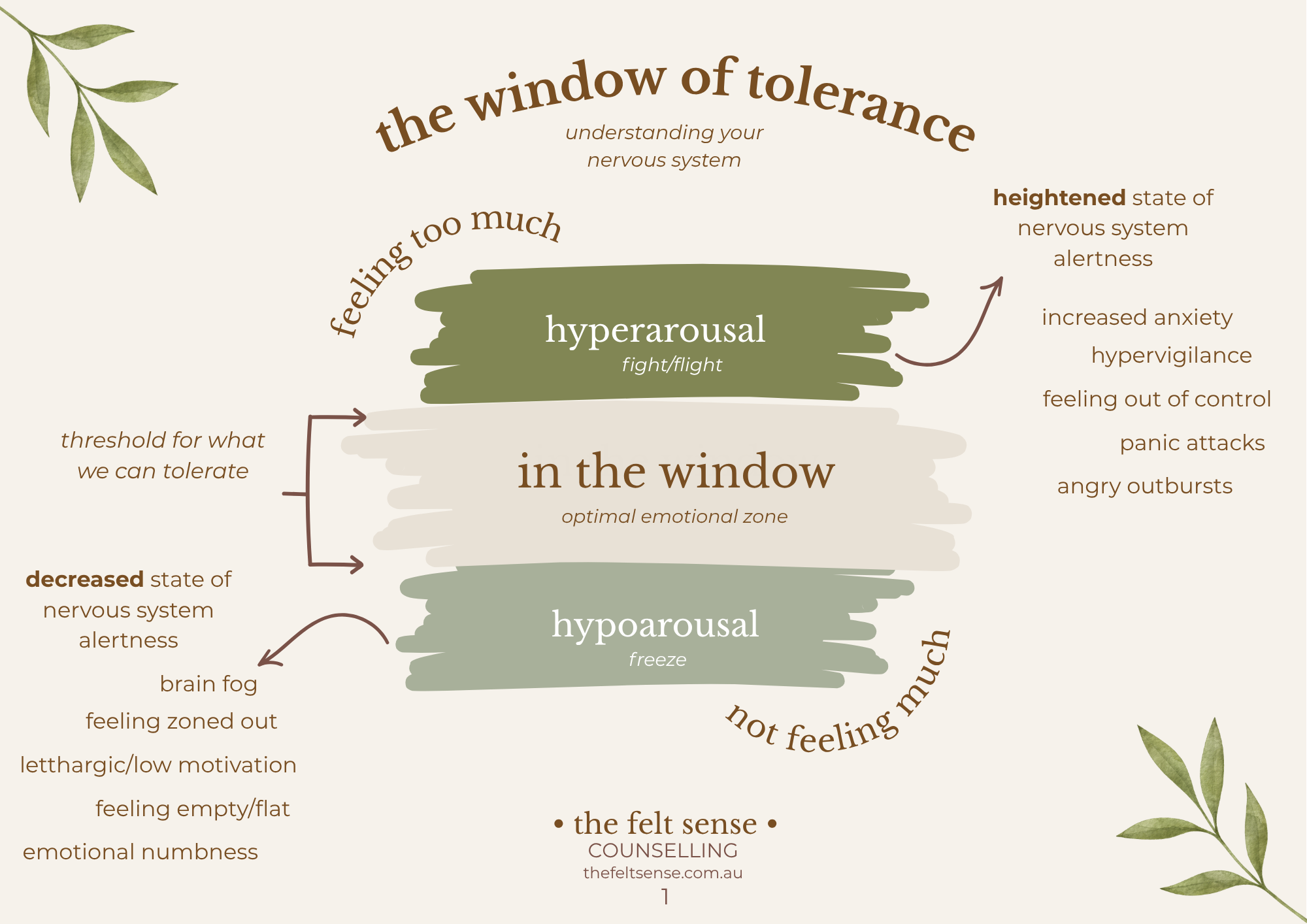
We might experience RSD as heat in our face, clenching fists, a tightening of our throat, or a drop in our stomach (like being in an elevator). The shame component of RSD may compel us to hide away to avoid further exposure or judgement, and it is here that the idea of our window of tolerance can be especially helpful. Rejection can propel us beyond the window of what we can tolerate within seconds, rendering our thinking brain effectively offline, and the survival part of our brain in full control. Above our window of tolerance, in a state of what’s known as hyperarousal (overt expressions of emotion), we might feel panicky, teary, furious, or urgent. Below our window of tolerance, in a state of what’s known as hypoarousal (subdued/internal emotional experiences), we might feel flat, foggy, disconnected or dissociated. With this in mind it can be useful to identify which direction rejection typically takes us, as this is providing us with valuable clues about what kind of support our nervous system is asking for.
Ways to manage rejection sensitivity
Feeling things deeply is often part of what makes neurodivergent people so perceptive and loyal, so it’s important to note that emotions are not a problem to be solved here. Instead, having strategies to manage these emotions, reduce our vulnerability to intense reactions, and widening our distress tolerance can help us ride the waves of rejection without feeling swallowed completely by it.
Name it
In the midst of an RSD experience, it can be helpful to simply say “this is RSD" to ourselves, even silently. This generates space between us and the feeling itself, where is a core way to reduce the hold the feeling has over us. This is a core skill of Acceptance and Commitment Therapy called Defusion, which might also prompt you to take things a step further and say to yourself “I notice that this is RSD”.
Respect the limitations of your nervous system
Before trying to use logic and think our way out of a rejection trigger, we need to give our nervous system the soothing that it requires to feel safe enough to do so. Our sympathetic nervous system (or our “fight/flight/freeze” system) makes thinking clearly difficult, which is why something body-based like paced breathing, grounding or sensory soothing like a heavy blanket on our lap can be helpful. This is because these strategies activate the parasympathetic nervous system (or our “rest and digest” system), which effectively brings us back into our window of tolerance, and brings the thinking brain back online.
Pause before responding
RSD can bring with it the urge to act on emotions immediately, like overapologising/people pleasing, pulling away or reacting aggressively. To build control over our responses, it can be helpful to give ourselves a circuit breaker, like writing down what we want to say and giving it 30 minutes before acting, or going for a walk before coming back to a conversation.
Check the facts
This strategy stems directly from Dialectical Behaviour Therapy, and is most effective when we are closest to our window of tolerance, when the thinking brain is online. We can ask ourselves what we truly know about the rejection inducing situation, versus the gaps that our mind may be filling in with schema-driven information. For example: “they changed the subject” is a fact, however, “they think I am boring” is a story and it may not be one grounded in truth/facts we can deduce from the current situation.
Vulnerability factors
Also from Dialectical Behaviour Therapy (DBT), vulnerability factors are any experiences that can make us more susceptible to intense emotions. Hunger, Anger, Loneliness and Tiredness (HALT) are the factors traditionally discussed in DBT, however The Felt Sense’s neuroaffirming vulnerability factors include Autonomy restrictions, Masking, Burnout, Unfamiliar environments, Sensory sensitivities and Hormones (AMBUSH).
Soothing your vulnerable child
Schema therapy suggests that our vulnerable child needs comfort and nurturance rather than correction or criticism. This is also the space in which we stand to experience the most healing work, as by soothing our vulnerable child, we can help to heal unmet needs from the past. When a rejection trigger emerges, try asking what you might say to a younger version of you who felt left out, then direct this towards yourself. This could be a letter you write and can read back over, or if words are difficult to find, behavioural self-care (activities that help us feel safe and connected) can be a good alternative for channelling our happy child mode instead.
How counselling at The Felt Sense can help
Rejection sensitivity can feel most manageable once we are aware of its roots and where it has originated from. In sessions we go slowly by paying careful attention to what your body is telling you as well as the meaning your mind is making. We draw on schema therapy to understand the old beliefs that arise, and on DBT for practical skills that help when the waves of emotion hit. Parts work from Internal Family Systems can help us get to know the critic and the protector with curiosity rather than shame. All of this sits inside a neuroaffirming frame, from which your brain is understood on its own terms. A formal ADHD or Autism diagnosis is not required for this work to be worth exploring, and if you recognised yourself somewhere in this piece, we'd love to hear from you. Please feel free to book a complimentary 15 minute meet and greet to get an idea of how The Felt Sense Counselling operates.
If you're in distress right now, you can call Lifeline on 13 11 14 at any hour.
