Why Does Everything Feel so Embarrassing?
A guide to why everyday tasks can trigger shame, and what Schema Therapy, Intersectionality and Brene Brown's shame research can teach us about it.
Daily social tasks as a human seem like they should be objectively tolerable. Things like ordering a coffee, texting someone back, or contributing during a work meeting may not seem like much, but it is in these subtle activities that shame responses permeate. Our chest might tighten, or our face might flush red, whilst our mind actively judges us - reminding us in no uncertain terms that we have done something embarrassing or judgement worthy. It is in this very social exposure that we can fall vulnerable to the debilitating emotion called shame.
What is shame? Why does it show up so often?
According to Brene Brown’s incredible book Atlas of the Heart, shame is defined as:
The intensely painful feeling or experience of believing that we are flawed and therefore unworthy of love, belonging and connection.
Although it is often used interchangeably with words to describe similar emotions, such as guilt, it is important to distinguish shame as its own uniquely haunting emotion. That is, guilt focuses on behaviour. It is the discomfort we feel when we believe that what we have done/failed to do is against our values. It is underpinned by the belief “I have done something bad”. Importantly, shame focuses on the self, rather than the behaviour. It is the feeling of being flawed and unworthy of love/belonging or connection, and it is underpinned by the belief “I am bad”. Unlike guilt, which can motivate us to change behaviour, shame becomes internalised as a personal flaw and serves no overt adaptive purpose.
“People often want to believe that shame is reserved for the unfortunate few who have survived terrible traumas, but this is not true. Shame is something we all experience. And while it feels like shame hides in our darkest corners, it actually tends to lurk in all of the familiar places, including appearance and body image, parenthood, family, parenting, money and work, mental and physical health, addiction, sex, aging and religion.”
Brene Brown, I Thought it was Just Me (but it isn’t). Making the Journey from ‘What Will People Think?’ To “I am Enough”
With this in mind, the legacy from unmet needs and/or trauma that we carry from early life, coupled with ongoing messages from the media, pop culture and society more broadly, it is little wonder as to why shame has the potential to affect every aspect of our existence. Simple tasks may be underscored by the expectation of judgement from others, leading us to believe that we are undesirable, undeserving or inherently wrong in who we are.
An intersectional lens on self-monitoring due to shame
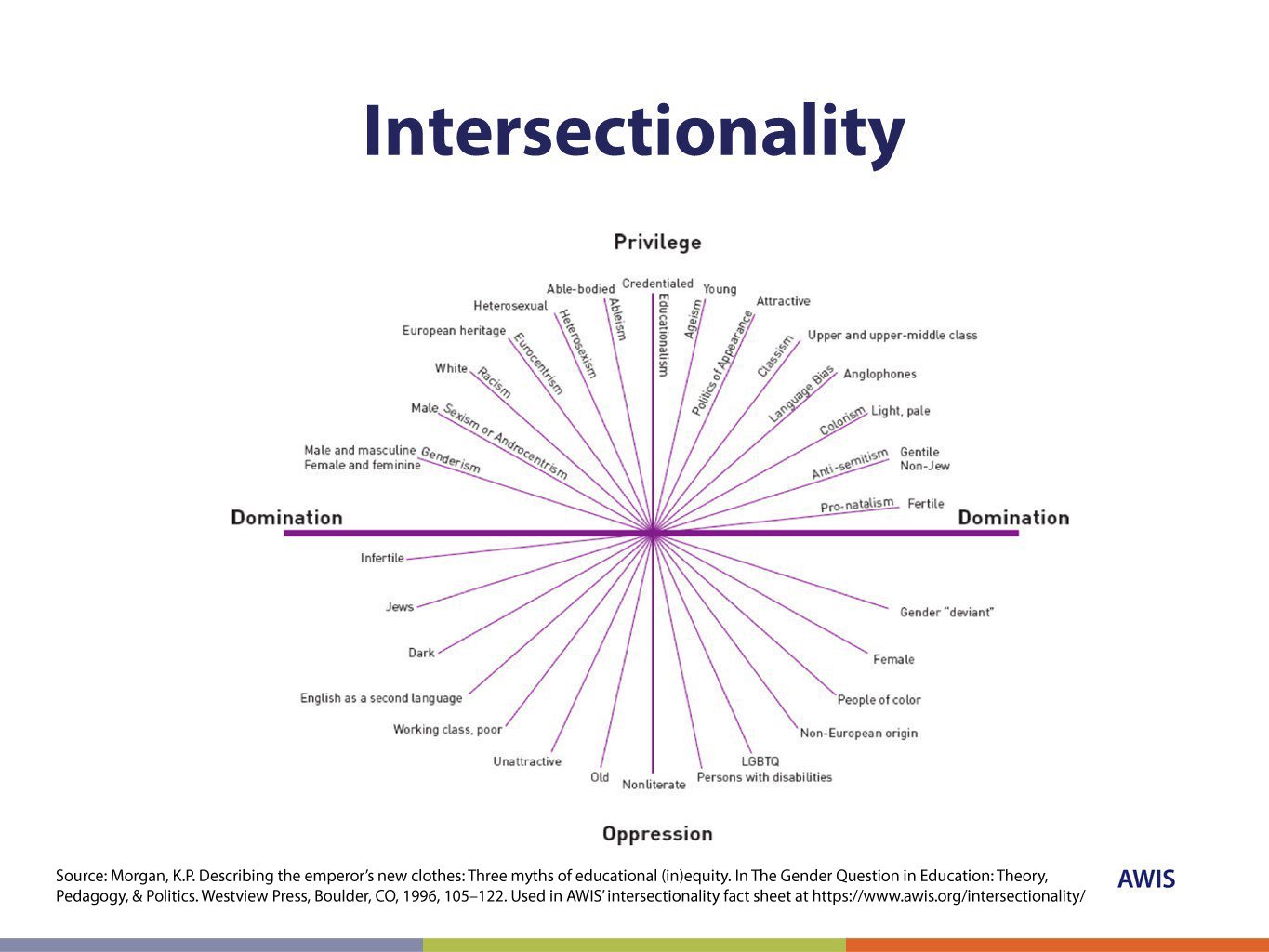
Intersectionality was developed by the incredible Kimberly Crenshaw, and refers to a framework for mapping how the different parts of a person’s identity (for example, race, gender, class, sexuality, neurotype) can contribute to unique experiences of discrimination or privilege.
Given the structural, political and systemic dynamics constantly at play in our world, it is a sad reality that people belonging to marginalised groups are likely to experiences additional and often overlapping layers of disadvantage, and with that, shame experiences.
Many women and girls (cis and trans) and AFAB people grow up being taught to monitor themselves constantly, often being praised for exhibiting traits such as being passive, palatable to others and not taking up too much space emotionally. This is additionally prevalent for women of colour, in that there exists another layer of social disadvantage that may elicit criticism, silencing or social isolation, particularly with regard to one’s subscription to cultural norms and customs. This is again multiplied for those belonging to LGBTQIA+ identities. It is here that these socialisation experiences can lead to the internalisation of shame based beliefs, which are often dictated and enforced by those with the most privilege and power in society. An helpful diagram has been included below to visually display how these dynamics of power and oppression shape identities and associated shame narratives.
Similarly, for neurodivergent or disabled folk, shame narratives may have additional material to draw from. That is, years of existing in spaces not designed with non-ablebodied/neurotypical needs in mind can solidify into beliefs of unworthiness. These experiences often begin early in life, wherein we begin to internalise these constant criticisms or lack of accessibility as “something about how I exist is wrong”. Our nervous systems may have learned that being visible whilst navigating the world was risky, and likely to lead to exclusion and/or the feeling of being different or “othered”.
This is by no means an exhaustive list of how intersectionality contributes to shame, but rather, is intended to provide a few examples of how it may play out in day to day life. Ultimately, the crux of the idea lies in the fact that marginalised identities lead to increased self-monitoring and the conflation of exposure/visibility with shame.
A Schema Therapy view of shame
Schema Therapy provides us with the language to explain the beliefs driving shame. The Defectivess/Shame schema refers to an early-formed way of experiencing ourselves, others and the world, underpinned by the belief that we are flawed at our core. Further, if people saw the real, authentic version of us, unmasked, they may find us unacceptable, too little/too much, or hard to love. Through repeated experiences in which this belief is reinforced (for example, being harshly punished by our caregivers, abuse/neglect, or bullying experiences at school), the schema gains traction, and begins to set as a default lens through which we view our reality when we are in a shame-inducing situation.
How schemas show up as coping styles
Schema therapy suggests that we employ one of three styles of coping when our schemas are activated. This is not something we consciously do, but rather, it becomes an automatic coping process based on what we learned was effective early in our life. For a person with a Defectiveness/Shame Schema, this might look like:
A triggering situation (e.g., making a social mistake)
In order to cope, we might:
Fight (otherwise known as “overcompensate” in schema terms) - coming across as unbothered, overly critical of others, or fiercely independent in order to prevent others from getting close enough to discover any of our perceived flaws.
Flight (otherwise known as “avoid” in schema terms) - dodging situations where our flaws might get noticed, such as cancelling plans, silencing ourselves in social situations or avoiding new places/meeting new people in future.
Freeze (otherwise known as “surrender” in schema terms) - agreeing with our shame beliefs internally. If we surrender to the belief that we are inferior/defective, we might over-apologise, prioritise other people’s needs, or automatically assume that things are always our fault.
How shame can turn into a story
For people with a deeply ingrained Defectiveness/Shame Schema, our internal dialogue can consist of frequent involuntary thoughts and/or memories that induce shame narratives. This might look like a harsh inner critic that tells us the story that we are unworthy and unlovable by replaying a memory of a time of perceived failure. Alternatively, it may be an anxious part of us that tells us that we will be incapable of achieving our hopes and dreams due to our inherent inadequacy, and rushing to urgently find solutions. Sometimes it’s an amalgamation of stories from several parts, showing up in the form of something like Imposter Syndrome, which can feel like it sabotages our chances of trying something new and proving our inner critic wrong.
Common to all of these experiences is the idea that these thoughts, memories and parts of self are telling stories. These stories are pictures and words generated by our brain, informed by our past experiences. This is absolutely not intended to trivialise the pain that these stories can cause us, especially if we fuse with them over time and see them as facts about ourselves. But the important part here is to recognise that these stories are not inherently true, regardless of how convincing they may seem. And if we remain entangled with them, it can feel impossible to shift the lens and to tell ourselves (and believe in) a different story - one that we get to decide on.
What to do about ongoing shame
Brene Brown suggests that shame needs specific conditions to survive, and that these conditions are secrecy, silence, and judgment. Take any one of those away and shame starts to lose its grip. This is precisely why it thrives in isolation and struggles in connection. Shame cannot survive being spoken. It depends on staying unspoken.
This is why naming the pattern is a helpful first step. Noticing "this is my Defectiveness/Shame Schema. It does not have an accurate read of the situation" can create an opportunity to pause between the belief being triggered and the reaction. Many people find that by creating this psychological distance, over time they are able to practice reinforcing new, more self-compassionate stories (e.g., I made a mistake and this doesn’t mean that I am a bad person).
Another helpful step can be unsilencing the shame. This means verbalising it out loud to a trusted person, to ourselves, or even writing it down in a journal. This verbalisation does not have to include the most vulnerable details of the shame narrative, but should still aim to cast a spotlight on its isolating element. For example, telling the right person/writing in a journal something we fear like “I actually feel really scared about becoming a parent” allows us to expose the shame driving a self-criticism, taking it out of the shadows where it thrives, and empowering us despite our vulnerability.
Although reading about the Defectiveness Schema and shame narratives can be a helpful first step, sometimes it can be beneficial to explore your own experiences in a safe, non-judgemental therapeutic space. If shame narratives are impacting your daily life, The Felt Sense Counselling can help, specialising in trauma and attachment injuries using Schema Therapy and EMDR in Melbourne and online. Book a free 15 minute chat to find out what working together could look like.
