A schema therapy guide to the four communication styles, why assertiveness feels so uncomfortable, and where these patterns stem from.
What are communication styles?
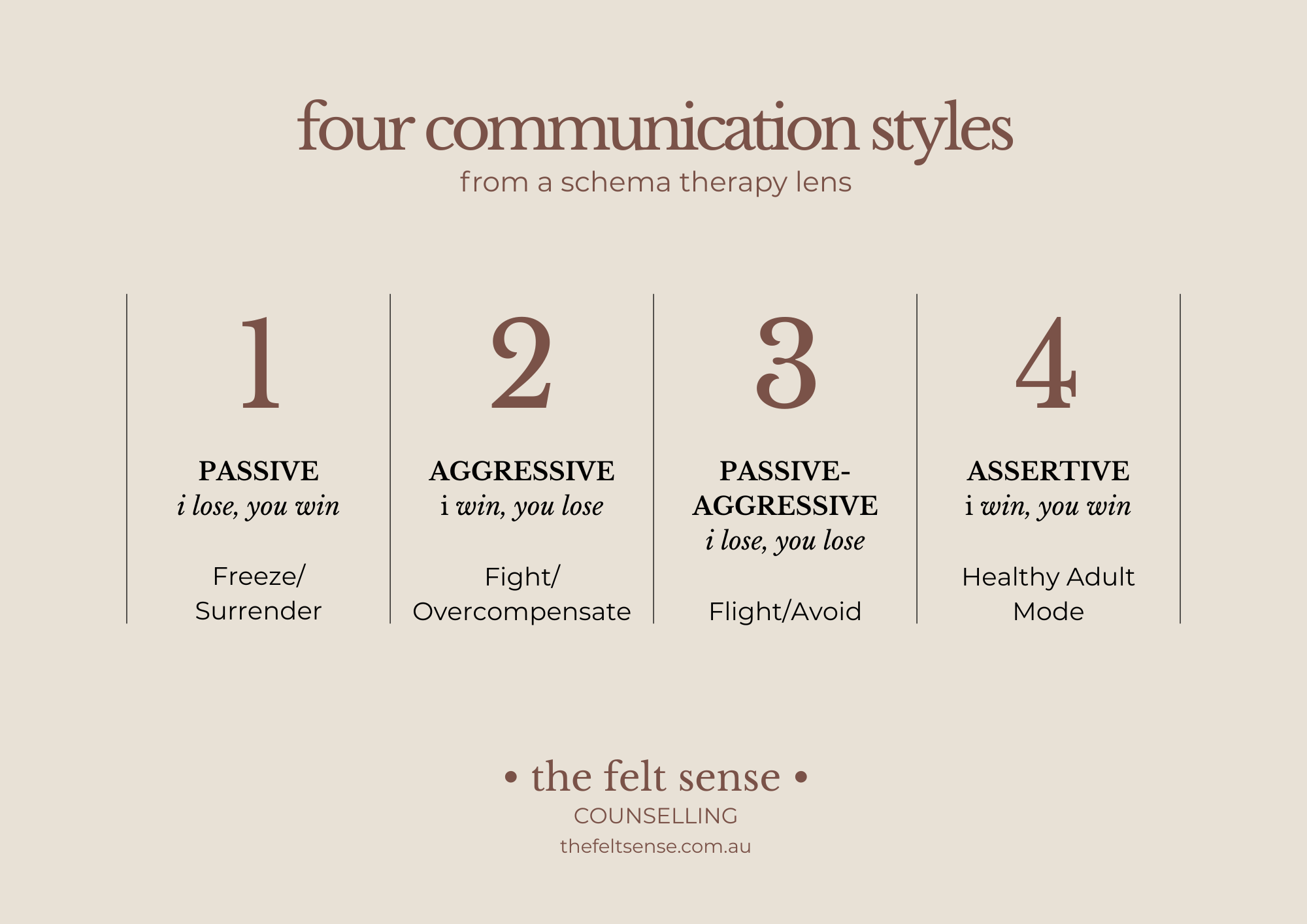
As humans, our way of communicating typically fits into one of four styles. It is important to note that these styles may fluctuate based on who we are interacting with, and how safe we feel:
Passive Communication:
Going quiet, avoiding asserting your needs in fear of conflict or rejection, allowing others to dominate or make decisions at the expense of your own emotions or needs. In simple terms it can be understood as an “I lose, you win” dynamic, as the communicator loses out on clearly stating their needs and prioritises the needs of the receiver.
Aggressive Communication:
Dominating an interaction through force, coercion or manipulation. This can be verbal (through yelling, swearing or otherwise using the threat of force to get what you want) or physical (overt violence). In simple terms it can be understood as an “I win, you lose” dynamic, as the communicator uses domination and fear to hold power over the interaction.
Passive Aggressive Communication:
Expressing needs or emotions indirectly, using things like sarcasm or silence to send a message without communicating this message directly. In simple terms it can be understood as an “I lose, you lose” dynamic, as the communicator’s needs are likely left unmet, and the receiver is likely left confused or unsure of what the communicator actually wants.
Assertive Communication:
Clearly stating your needs, emotions or thoughts without minimising yourself to others, while still leaving room for the other person to do the same. In simple terms this can be understood as “I win, you win”, as both the communicator and the receiver experience a fair, balanced interaction with clear messaging from the other.
Of the four styles, it is widely recognised that assertive communication reflects a healthy, balanced self. Being assertive means confidently articulating our needs, decisively saying no where it’s needed, and doing so without apologising unnecessarily or acquiescing - which expresses both strong self-esteem and respect for self and others. This may seem simple in theory, but for many people, it feels inaccessible and even unnatural. Assertiveness is a skill that we learn, but for a lot of us, it wasn’t something we were taught. For others, it was actively discouraged.
Where do our communication patterns come from?
The way we learn to communicate with others is shaped early in our lives through our experiences within our family of origin. Often referred to as attachment shaping experiences (or attachment injuries when things go wrong), the way our caregivers model communication and conflict resolution to us has the potential to define the way we see ourselves and our needs in adulthood. Schema therapy names the beliefs underlying our communication styles as Early Maldative Schemas. These are core views about ourselves and others that shape how we interact with the world. Nobody is fundamentally born passive or aggressive, but rather, we learn to communicate our needs the same way we’d learn a language - by watching what worked and what did not in the environment we grew up in. Schema therapy also posits three broad ways in which people cope with these beliefs/schemas once they are formed: overcompensating against it (fight response), avoiding anything that triggers it (fight response) or surrendering to it (freeze response). Interestingly, these three styles translate quite well onto the four communication styles, which can help us build insight into the underpinnings of certain behaviours we might notice in ourselves in our relationships with others.
Aggressive Communication and the Overcompensate (Fight) Response
Witnessing the use of violence to solve problems or communicate needs early in life will likely lead to a child internalising an aggressive communication style. They may learn that others cannot be trusted, or will ultimately abandon or betray them, resulting in a hard exterior that aims to compensate against these painful, ancient beliefs. This might look like a person that raises their voice easily, dominates conversations/intimidates/controls others, bullying behaviours, or overt violence.
This can trace back to schemas like Mistrust/Abuse, which leads to a default conclusion that, if we don’t hurt first, someone else will hurt us. Alternatively, a Defectiveness schema may be at play here, where appearing strong and in control becomes a protective mechanism for ensuring others cannot see the vulnerability at our core. From the outside, these behaviours can appear confident, self-assured or entitled, but underneath there is very likely a vulnerable child seeking protection at all costs. This is particularly true in forensic environments.
Passive Communication and the Surrender (Freeze) Response
“When prioritising the needs of others is all we know, assertiveness can feel like aggression”.
Learning that other people’s needs have to come first, like in instances of parentification (where a child is forced to take on adult responsibilities like acting as a caregiver for parents or siblings), can lead to a child internalising a passive communication style. They may learn that asking for their needs to be met receives criticism, conflict or danger, resulting in a compliant part of themselves developing to keep the peace.
This can stem from a Subjugation schema, which is grounded in the belief that danger may arise (like being criticised or rejected) if we do not prioritise another person’s needs. Another related experience is that of the Self-Sacrifice schema, which can lead to a critical voice within us that labels us as “self-indulgent” or “selfish” for having needs or setting boundaries.
Passive-Aggressive Communication and the Avoid (Flight) Response
For children that witnessed the avoidance of direct communication in the family home (like sarcasm from caregivers), or indirect messaging (like caregivers slamming doors instead of explicitly addressing an emotion or need), they are likely to internalise a passive-aggressive communication style. They may learn that direct communication is not safe, or risks rejection or something else unpleasant, so indirectness feels safer.
This can develop alongside an Emotional Inhibition schema, which is grounded in the belief that expressing emotions directly isn’t acceptable. Without the safety to be direct, this can lead to a lot of internal frustration about unmet emotional needs. This can lead to a misplaced attempt at communication (e.g., sarcasm), which makes their displeasure obvious to others, without clearly addressing it’s honest roots.
Assertive Communication and the Healthy Adult Mode
Assertive communication aligns with what schema therapy terms the Healthy Adult Mode. This is a part of us that is capable of seeing our intrinsic worth, advocating for ourselves and setting boundaries with others. When a person has developed a strong Healthy Adult Mode, they can communicate assertively, including confidently saying no, respectfully disagreeing, and having difficult conversations without shutting down or dominating the other person.
It is important to note that the Healthy Adult Mode can take some time to develop, and is much like a language in the way that the other communication styles are. This can feel daunting, especially because our communication styles and the schemas underneath them have usually developed to keep us safe, and disrupting this familiarity can feel destabilising.
How to be more assertive
Whilst building comfort with assertiveness can take time, here are some simple steps to get started:
Starting with low-stakes decisions.
Practice being assertive with close friends in low-pressure environments, like choosing a restaurant or a movie. This can begin to strengthen the psychological muscles we will eventually need for more difficult situations demanding greater assertiveness in future.
Ride the wave of discomfort.
Assertiveness can feel very wrong, even rude, when we aren’t used to it, even when we are perfectly within our right. Accepting that a level of discomfort will likely arise in these instances is an important step in building our tolerance.
Opposite action
Notice which communicaiton styles you are most likely to embody, then practice one small step of acting the opposite way. For passive communicators, try saying one true thought or feeling out loud, even when alone, to allow yourself to hear assertiveness in your own voice. For aggressive communicators, try pausing for a brief moment before responding in a mildly triggering situation. For passive-aggressive communicators, try naming the frustration or need directly by writing it down first.
Want to work on this with support? Book your free 15-minute consult with The Felt Sense Counselling and see what building a more assertive communication style can look like.
