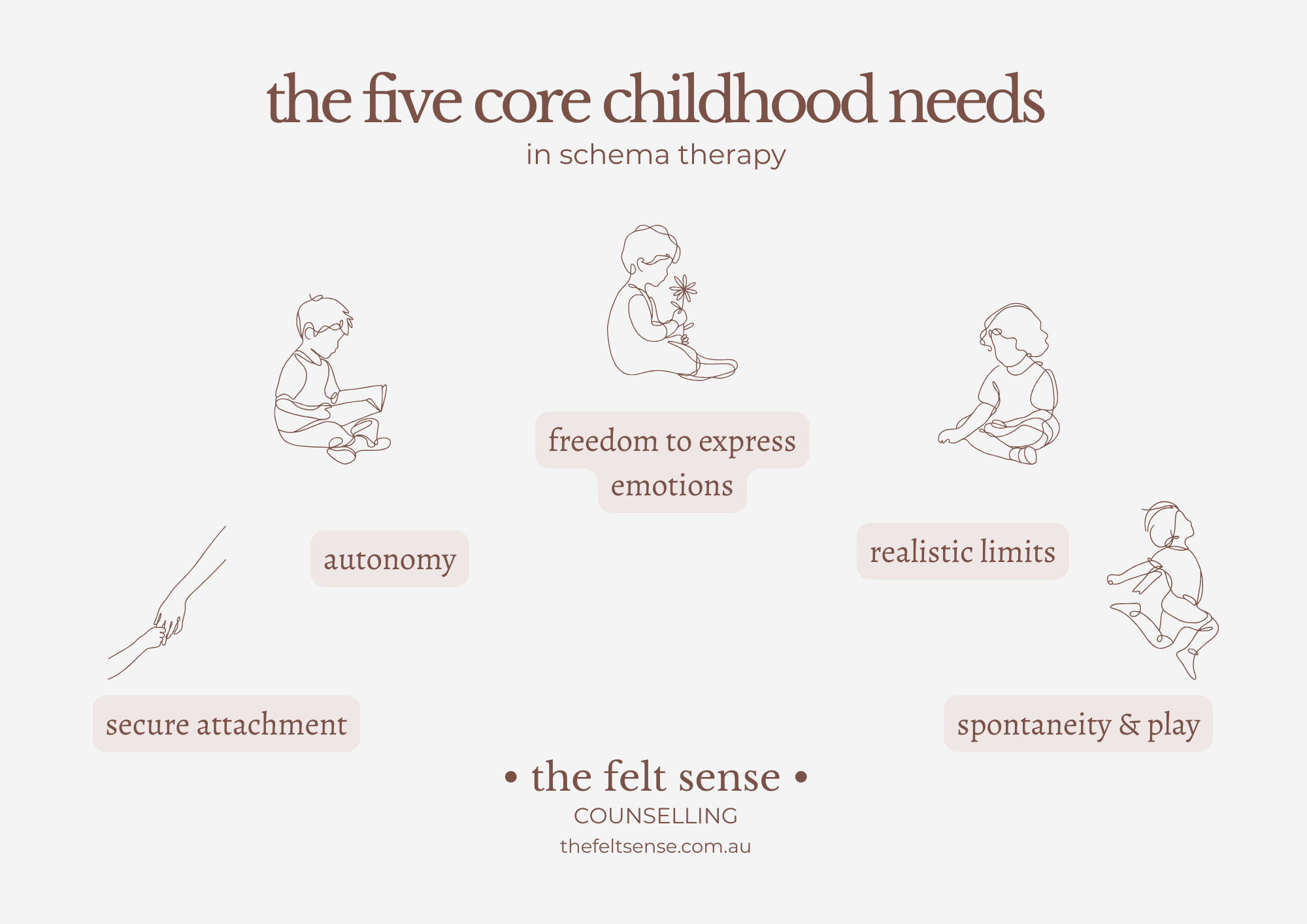
The 5 Core Childhood Needs in Schema Therapy
A dialectical look at the needs we're all born with, and what happens when they go unmet.
The foundation of Schema Therapy traces back to core human needs. That is, it suggests that every child is born needing the same fundamental things and that the rest of our life timeline is influenced by the extent to which these needs were/were not fulfilled. When one of our core needs goes frequently unmet, this contributes to the development of the blueprint through which we come to understand the world. Oftentimes children will internalise an unmet need as a personal internal deficit (i.e., the belief that one must be unlovable if their caregiver is emotionally unavailable). Children may believe that there is safety and control in attributing blame to self, rather than accepting that their relational world is unpredictable and turbulent. As such, these foundations are laid in their developing minds, making it difficult to challenge these emerging beliefs about the self and the world.
Understanding the core childhood needs can be confronting and painful. Sometimes people may experience a variety of emotions when reflecting on this, including sadness, grief and even guilt about considering the ways in which our caregivers may have struggled to emotionally provide for us. However, it is important to understand that two truths can co-exist here:
Our caregivers did not always meet our needs AND they were doing the best with the tools that they had at the time.
Our caregivers struggled to show up for us emotionally AND they still held love for us.
Viewing this through a dialectical lens (i.e., holding space for two concurrent truths), is often important in capturing nuance and promoting psychological flexibility. Understanding these five needs isn't about assigning blame to the people who raised us, but rather, it is about making sense of our life patterns that might otherwise feel confusing or like a personal flaw.
Secure Attachment
One of our most important relational needs is the need to feel securely attached to at least one consistent, emotionally available caregiver. In order to provide this security, this person needs to be there enough of the time, responding to us with warmth and validation. This doesn’t have to be perfect attunement to our every need, but rather, what researchers sometimes call “good enough parenting”. This means that a caregiver is reliable in the ways that matter most. The dialectic here is that it is possible to be a good enough parent AND be an imperfect/tired human adult at the same time.
The extent to which this sense of attachment is available to us has the potential to dictate the template for which we base our future relationships on, including the capacity to trust others, and to feel safe with closeness/intimacy. In instances where this need goes unmet, whether that is a product of neglect, inconsistency, or even a caregiver who is physically present yet distracted or emotionally distant/unavailable, a child’s attachment system can absorb this. As an adult, this may manifest as:
Needing frequent reassurance that a partner still loves you, in the absence of any information to the contrary.
Automatically panicking when a message goes unanswered for a few hours.
Feeling suffocated/trapped when a relationship starts to become close emotionally.
Feeling more attracted to partners that are emotionally unavailable, and feeling more chemistry with unpredictability than consistency.
Interpreting another person’s healthy boundaries as rejection/a direct criticism.
This need is directly linked to the Disconnection/Rejection domain, which contains the following schemas: Abandonment, Mistrust/Abuse, Emotional Deprivation, Social Isolation, and Defectiveness/Shame.
Helpful dialectics for a securely attached healthy adult:
I expect people I love to leave me AND that expectation was shaped by the past: it’s not a guarantee about the present.
My nervous system learned that connection was unpredictable AND it can now learn that connection can also be steady.
I can crave reassurance from someone I love AND I can also learn to offer that reassurance to myself.
Autonomy and Competence
The second need relates to a child having opportunities to develop their own unique sense of self, independent from their caregivers. Having access to such opportunities creates scaffolding that allows us to feel capable of navigating the world autonomously, without heavy reliance on others. Examples of these opportunities might include being allowed to make age appropriate decisions, try new things and get them wrong, and gradually build confidence in your own judgement and decision-making.
Children who are overprotected, or whose independence is discouraged in the name of safety/convenience, often develop a template in which they automatically doubt their own competence, even in areas they possess genuine skill and expertise. As an adult, this may look like:
Automatically believing that you need permission before doing things (e.g., grabbing a glass of water at a friend’s house, making decisions within your job description at work).
Deferring decisions to a partner, parent or friend due to the belief that you are incapable of making the right call.
Seeking constant reassurance before making a choice due to difficulties with self-trust.
On the other end of the spectrum, some children are given autonomy far too early. This may result in them being expected to manage adult responsibilities before they were ready, producing a different kind of adult exhaustion, grounded in not having had the space to be a child in the first place. As an adult, this may look like:
A puzzling dialectical sense of both having missed out on childhood AND pride in how capable you had to become.
Difficulty asking for help from others, given the familiar pattern of constantly being the one who helped others (often stemming from what’s called “parentification”: a role reversal where children are expected to take on adult or caregiver responsibilities/conversations that they may not be developmentally ready for, like caring for their parents or siblings).
This need is directly linked to the Impaired Autonomy domain, which contains the following schemas: Dependence/Incompetence, Enmeshment, Failure and Vulnerability to Harm.
Helpful dialectics for an autonomous healthy adult:
Part of me still expects to be told what to do by others AND I’m capable of deciding for myself even when it feels unfamiliar/scary.
My confidence was undermined before I had the chance to build it AND it isn’t too late to still build it now in manageable ways.
I was corrected so often that trying new things felt risky AND getting something wrong was never proof that I couldn’t still do it.
Freedom to Express Emotions and Needs
The third need involves a child having the freedom to express their own emotions, and to have these emotions validated and seriously considered rather than dismissed/punished. Children that are scolded for crying or for expressing a natural range of human emotions may quickly learn that certain feelings are unacceptable and likely to elicit rejection/invalidation from their caregivers. This is particularly true for neurodivergent folk, who may have received countless more corrections and developed a strong inner critic.
A child that was chronically shamed or invalidated for externally expressing their emotional world may become an adult who:
Apologising for crying in front of other people, even those in our inner circle.
Downplaying a difficult emotional situation to avoid appearing overly dramatic or “high maintenance”.
Feeling guilty for taking up emotional space in a conversation, even briefly.
Defaulting to people pleasing and suppressing your own feelings/needs after years of prioritising other people’s emotions over your own.
This often shows up in adulthood as someone who apologises for crying in front of others, or who has become so practiced at appearing fine that they've genuinely lost touch with what they're feeling until it becomes overwhelming. It can also look like someone who has learned to minimise their own needs before anyone else gets the chance to, saying "I'm fine, honestly, don't worry about it" almost reflexively, even when they're not fine at all. Over time, this need being unmet tends to feed directly into people pleasing and a persistent discomfort with taking up emotional space.
This need is directly linked to the Other Directedness domain, which contains the following schemas: Approval Seeking, Self-Sacrifice and Subjugation.
Helpful dialectics for freedom to express emotions as a healthy adult:
I can grieve what I didn’t get to feel back then AND give myself the space to feel it now.
I can crave comfort when I am upset AND also be capable of providing this comfort to myself.
I didn’t get to see what healthy emotional expression looked like growing up AND I can still learn it now.
Spontaneity and Play
The fourth need relates to having had space for spontaneous and playful moments of childhood joy and wonder. This might involve opportunities for creativity, silliness and/or fun, without every moment needing to be productive, purposeful or education. Play is the means through which children learn regulation and connection skills and its absence can contribute to the belief that the world is for seriousness only, with limited room for adventure.
Households where this need was not met may have been highly structured and/or achievement focused, or merely too stressed for playfulness to be accommodated. Adults that inhabited a household of this kind may:
Struggle to enjoy downtime unless it feels earned by a full day of productivity/achievement.
See hobbies as a performance/metric of success, including feeling the need to monetise hobbies/track progress or output instead of engaging in them for enjoyment and relaxation.
Feel self-conscious being silly/laughing loudly/being goofy in front of others, including safe people or in low stakes environments.
Believe that adults cannot enjoy fun/playfulness and still be a functioning, mature adult.
This need is directly linked to the Overvigilance/Inhibition domain, which contains the following schemas: Unrelenting standards, Emotional Inhibition, Self-Punitiveness/Punitiveness (Other), and Pessimism/Worry.
Helpful dialectics for a balanced healthy adult:
I learned that downtime needed to be justified/earned AND wanting rest is a valid enough reason to slow down.
I became serious and responsible before I had a chance to be playful AND it’s not too late to still reclaim a sense of playfulness now.
I feel guilty for doing things with no apparent practical purpose AND things without a purpose are still allowed to matter.
Realistic Limits
The fifth need involves children experiencing limits and boundaries that are appropriate and consistent. These boundaries need to be balanced, not being so rigid that they are punitive/harsh, but simultaneously not being so absent that a child loses structure/guidance. Setting realistic limits means helping a child understand that behaviours result in consequences, whilst also holding space for them to make mistakes without punishment. This core need reflect a very clear dialectic: boundaries are necessary in creating accountability/balance AND boundaries can be taught without harsh punishments.
When limits are too harsh children may develop into adults who:
Have an unforgiving, punitive inner critic.
When limits were absent or parenting was too permissive, children may develop into adults who:
Experience low tolerance for boredom, frustration or waiting.
Have difficulty setting boundaries with others, since this was not modelled to them.
Struggle with structure or routine even if this is what is desired.
This need is directly linked to the Impaired Limits domain, which contains the following schemas: Entitlement and Insufficient Self-Control. It is very important to note that the Insufficient Self-Control schema is quite punitively named, suggesting some kind of internal deficit in one that possesses this schema. This is further damaging for neurodivergent people, who this schema frequently shows up for. Please note that The Felt Sense prioritises neuroaffirming language, and that this schema (and any other schemas where jargon/clinical language doesn’t fit) can be reworded to align with your needs. It is also recognised that this need may be impacted by other factors independent of or in conjunction with early life experiences, such as executive functioning differences associated with neurodivergence.
Helpful dialectics for a boundaried healthy adult:
I didn’t have consistent structure as a child AND I am capable of building structure into my adult life now.
I grew up believing that structure meant control AND structure can be safe now that I get to decide what it looks like as an adult
I struggle to hold myself accountable without feeling ashamed AND I can recognise that shame and accountability are not the same thing.
Why This Framework Is Useful
Our childhood core needs, and their impacts in adulthood, are not always widely understood. They can manifest in forms of extremes, including all-or-nothing thinking, resulting in rigid beliefs we now hold about the world and about herself. This can keep us stuck in patterns that continue to disempower us, which can keep us in a feedback loop from the past. By understanding these needs in a dialectical way (i.e., acknowledging that more than one truth can exist at once), we can work towards meeting our own need through choices and actions informed by our healthy-adult self in the present.
If any of this resonates and you'd like support making sense of your core needs, The Felt Sense offers trauma-informed, neuroaffirming counselling in Thornbury, Melbourne, and via telehealth Australia-wide, drawing on Schema Therapy and other approaches. Medicare rebates are available with a Mental Health Care Plan. You're welcome to book a free 15-minute chat to see if it feels like the right fit, or find out more at thefeltsense.com.au.